
Analyse, Design,
Develop and Deliver
We listen to all your requirements, analyze it to design the right solution to best fit to fulfil your needs following Agile Software Development

What is Agile Software Development?
Agile software development is a modern, iterative approach to building software that focuses on flexibility, collaboration, and continuous improvement. Instead of delivering the entire product at the end of a long development cycle, Agile breaks the project into small, manageable units called iterations or sprints. Each sprint delivers a working version of the software, allowing teams and stakeholders to review progress, provide feedback, and adapt quickly to changing business requirements. Agile emphasizes customer involvement, cross-functional teams, and rapid value delivery.
Build a Agile Software solution

We listen
Understanding your exact requirements to provide you with best solution

Design technical solution
We design a perfect solution for your requirements, with latest technologies

Fast development
We use agile development process for faster and timely delivery

Deliver error free solution
We do thorough testing at alpha and beta so that we can deliver you an error free technical solution
Phases of Agile Software Development
Although Agile is iterative rather than strictly sequential, it typically follows these key phases:
Concept / Initiation
Define the project vision, business objectives, high-level requirements, and feasibility.
Requirement Gathering (Product Backlog Creation)
Break down requirements into user stories and prioritize them in a product backlog based on business value.
Sprint Planning
Select user stories for the sprint, define tasks, estimate effort, and set sprint goals.
Development (Iteration / Sprint Execution)
Design, develop, and test features continuously within short sprint cycles (usually 2–4 weeks).
Testing & Quality Assurance
Conduct continuous testing alongside development to ensure quality, performance, and security.
Review & Feedback (Sprint Review)
Demonstrate the working product to stakeholders and collect feedback for improvements.
Deployment / Release
Release the completed features to production or staging environments.
Retrospective & Improvement
Analyze what worked, what didn’t, and how processes can be improved in the next sprint.
Higher Transparency and Control – Clear visibility into progress, costs, and risks.
Reduced Project Risk – Issues are identified and resolved early through incremental delivery.
Enhanced Team Collaboration – Cross-functional teams work closely, improving productivity and ownership.
Agile software development enables organizations to build scalable, customer-centric, and high-quality software while staying responsive to change and market demands.
Benefits of Agile Software Development
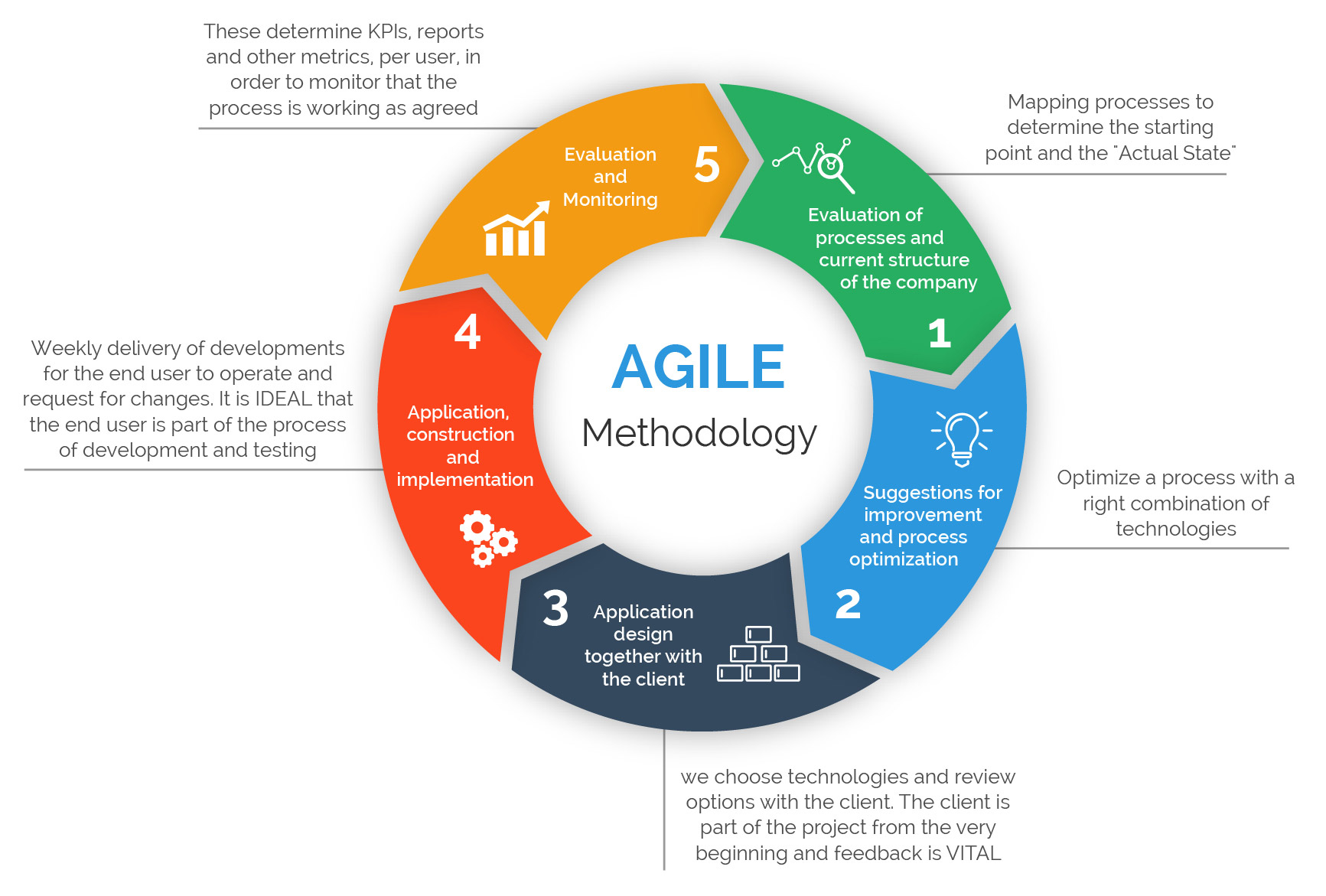
AGILE methodology is a practice that promotes continuous iteration of development and testing throughout the software development lifecycle of the project. Both development and testing activities are concurrent unlike the Waterfall model. The agile software development emphasizes on four core values.
It is a project management methodology characterized by building products that customers really want, using short cycles of work that allow for rapid production and constant revision if necessary.
Faster Time to Market – Working software is delivered early and frequently.
Flexibility to Change – Easy adaptation to changing requirements, even late in development.
Improved Product Quality – Continuous testing and feedback reduce defects and rework.
Better Customer Satisfaction – Regular stakeholder involvement ensures the product meets real business needs.
Agile software development enables organizations to build scalable, customer-centric, and high-quality software while staying responsive to change and market demands.