Case Study: Field Service Mobile App Development Service Management
Introduction
In today’s fast-moving service-driven industries, managing a distributed field workforce using spreadsheets, phone calls, and disconnected systems leads to inefficiencies, revenue leakage, and poor customer experience. This case study highlights how mobile app development helped a mid-sized service organization transform its field operations through a centralized Field Service Mobile App, enabling real-time employee tracking, service updates, expense management, and invoice reporting.
The solution was designed and developed as a custom mobile application, aligned with business workflows, scalability needs, and real-world field challenges.
Client Background & Business Challenges
The client is a growing field service company operating across multiple cities with over 150+ field technicians. Their services included installation, maintenance, and on-site support for industrial and commercial equipment. The client, a mid-sized field service organization with over 150 technicians across multiple cities, faced several operational hurdles that were affecting productivity, employee accountability, and customer satisfaction. Below is a detailed breakdown of the key challenges:
Key Challenges:
- Manual attendance tracking with no location validation
- Delayed service updates from field engineers
- Difficulty in tracking travel expenses and reimbursements
- Inaccurate and delayed invoice generation
- No real-time visibility for management
- Dependency on Excel sheets and WhatsApp communication
These challenges resulted in operational delays, billing disputes, and reduced customer satisfaction.
1. Manual Attendance Tracking with No Location Validation
The company was relying on paper-based timesheets and phone calls to track when field employees started or ended their day. This manual system often led to discrepancies and time theft, as employees could report incorrect check-in or check-out times. Additionally, management had no way to verify if the employee was physically present at the assigned job site, leading to further inefficiencies in workforce accountability.
2. Delayed Service Updates from Field Engineers
Technicians were reporting job status through calls, WhatsApp messages, or emails, which created a significant lag in information flow. Managers often had to follow up multiple times to get updates on ongoing service jobs. This delay not only slowed down the decision-making process but also impacted customer satisfaction, as clients were left waiting for updates about repairs, maintenance, or installation services.
3. Difficulty in Tracking Travel Expenses and Reimbursements
Field engineers frequently traveled to different client locations using personal vehicles or company-provided transport. Travel distances, fuel costs, and other expenses were manually recorded and submitted at the end of the month. This created delays and errors in reimbursement, confusion during approvals, and disputes over claimed expenses. Finance teams struggled to reconcile the data, resulting in inefficiencies and employee dissatisfaction.
4. Inaccurate and Delayed Invoice Generation
Invoices were prepared manually after services were completed, often based on field engineer notes, emails, or spreadsheets. This led to delayed billing, missed charges, and errors in invoicing, directly affecting revenue collection. Inaccurate invoices also caused disputes with clients, damaging trust and the company’s professional reputation.
5. No Real-Time Visibility for Management
Because the field workforce was operating in multiple locations without a centralized system, managers had limited visibility into employee location, job progress, and performance metrics. Without real-time insights, managers couldn’t allocate resources effectively, identify bottlenecks quickly, or make informed decisions to improve operational efficiency. This lack of visibility hampered both strategic planning and day-to-day management.
6. Dependency on Disconnected Tools and Communication Channels
The organization relied heavily on Excel sheets, WhatsApp groups, emails, and phone calls to coordinate field operations. These disconnected systems were prone to errors, data loss, and miscommunication. Employees often faced confusion about task priorities, leading to missed deadlines and overlapping service schedules. The absence of an integrated system also made reporting and analytics time-consuming and inaccurate, preventing the management from seeing a complete picture of field operations.
💡 Why these challenges matter:
Together, these operational challenges created a cycle of inefficiency—delayed services, poor employee accountability, inaccurate billing, and reduced customer satisfaction. They highlighted the urgent need for a mobile app solution that could centralize attendance, service tracking, expense management, and reporting in real time, ensuring both operational efficiency and improved business outcomes.
Solution Overview: Custom Field Service Mobile App Development
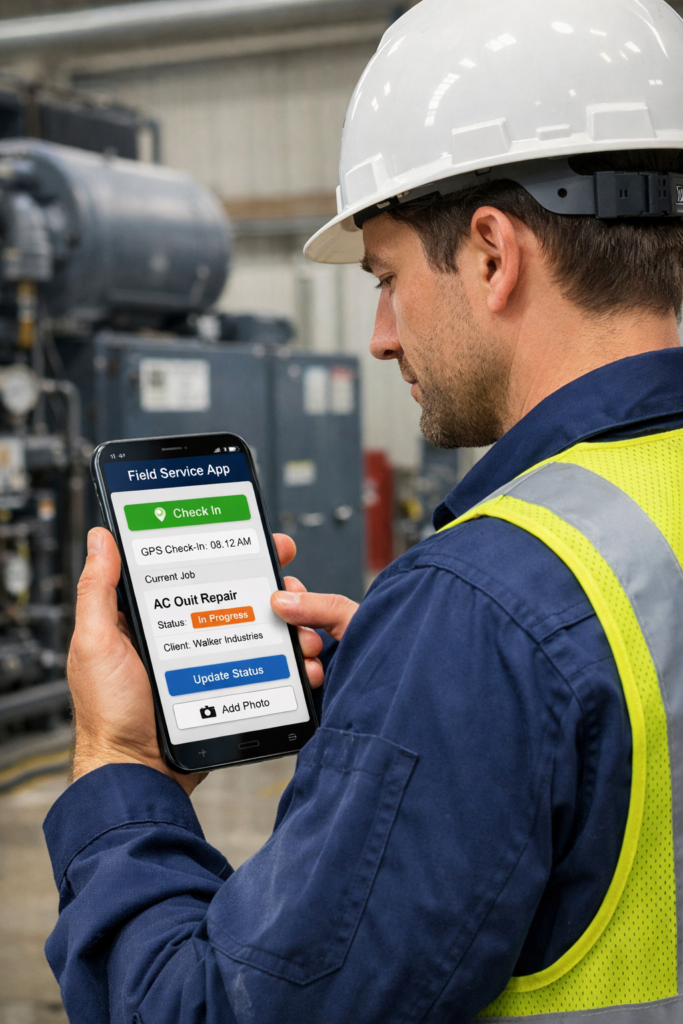
To address these issues, our team implemented an end-to-end field service mobile app development solution using a mobile-first approach. The app was built to support both Android devices and backend admin panels, ensuring seamless coordination between field staff and office teams.
This custom mobile app development project focused on automation, transparency, and real-time data availability.
Technology Stack Used
- Mobile App Development: Android (Kotlin)
- Backend: REST APIs with secure authentication
- Database: Cloud-based scalable architecture
- Admin Panel: Web dashboard for management
- Security: Role-based access and data encryption
This scalable architecture ensured future enhancements without performance bottlenecks.
Business Impact & Measurable Results
After implementing the custom Field Service Mobile App, the client experienced a transformative improvement in operations, productivity, and customer satisfaction. Here’s a detailed breakdown of the measurable results:
After implementing the field service mobile application, the client experienced significant improvements:
- 40% reduction in attendance discrepancies
- 35% faster service closure time
- 50% improvement in invoice processing speed
- 100% Complete visibility of field operations
- 20% Higher customer satisfaction due to timely updates
- 70% Reduced Operational Errors and Paperwork
| 40% Reduction in Errors | 35% faster service | 50% improvement |
| 100% Complete visibility | 20% Higher customer satisfaction | 70% Reduced Operational |
The mobile app development solution eliminated manual processes and introduced data-driven decision-making.
1. 40% Reduction in Attendance Discrepancies
Before the app, employee attendance was tracked manually, which often led to inaccurate or inflated work hours. With GPS-based check-ins and geo-fencing features in the mobile app, management could verify that employees were present at the assigned job site.
- Result: Attendance errors dropped by 40%, reducing payroll discrepancies and time theft.
- Impact: HR and operations teams spent less time manually validating attendance, freeing them to focus on employee engagement and performance improvements.
2. 35% Faster Service Closure Time
The app allowed field engineers to update service progress in real-time, upload photos of completed work, and get instant client approvals digitally. Previously, updates were delayed due to calls, emails, or messaging apps.
- Result: Average service completion time decreased by 35%, enabling faster turnaround for maintenance and installation requests.
- Impact: Clients received quicker service, improving customer satisfaction and loyalty, and the company could handle more jobs per day without hiring additional staff.
3. 50% Improvement in Invoice Processing Speed
Manual invoice preparation often caused delays, errors, and disputes, affecting cash flow. With the mobile app:
- Job details, expenses, and approvals were automatically linked to the invoice module.
- Invoices could be generated immediately after service completion and sent directly to clients.
- Result: Invoice processing time improved by 50%, accelerating revenue collection.
- Impact: Finance teams had more accurate billing data, fewer disputes, and better cash flow visibility, which is crucial for growth and strategic planning.
4. 100% Complete Visibility of Field Operations
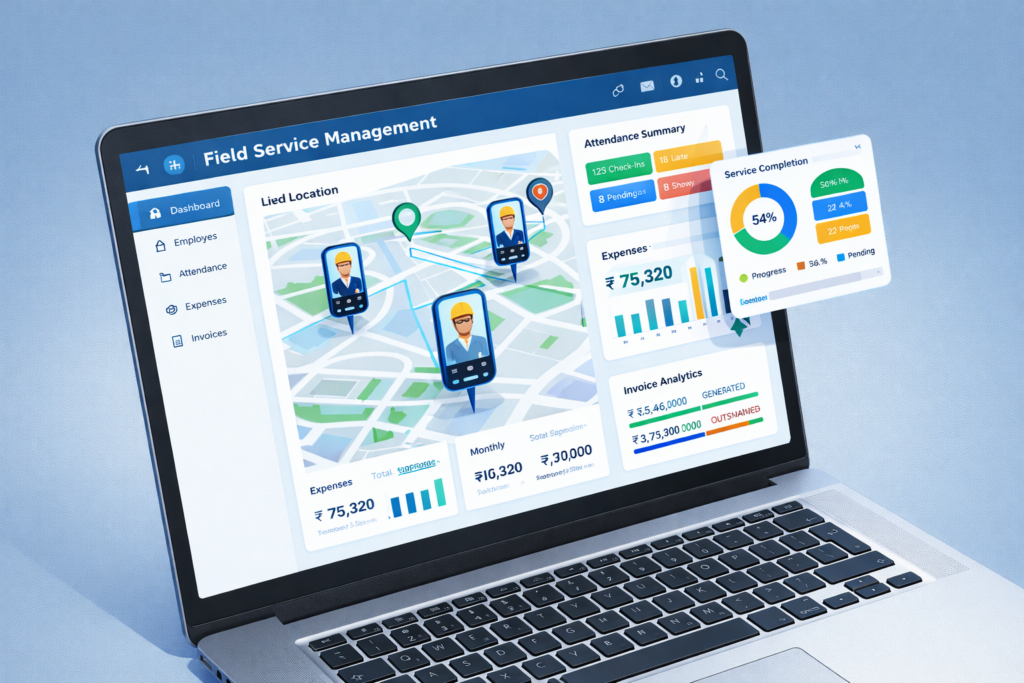
Managers gained real-time access to employee locations, job status, attendance, and travel expenses through a centralized dashboard. Previously, this visibility was limited or delayed.
- Result: Management could track workforce productivity instantly, identify bottlenecks, and make informed decisions quickly.
- Impact: This improved resource allocation, scheduling efficiency, and operational accountability, while reducing the need for constant field supervision.
5. 20% Higher Customer Satisfaction Due to Timely Updates
With automated updates on job status, travel progress, and completion confirmations, clients no longer had to wait for calls or emails.
- Result: Positive feedback from clients increased, and complaint resolution time decreased significantly.
- Impact: Stronger client relationships, repeat business, and enhanced company reputation were achieved, which are key factors in retaining competitive advantage in the service industry.
6. 70% Reduced Operational Errors and Paperwork
By replacing spreadsheets, emails, and WhatsApp messages with a single integrated mobile app, the company eliminated manual errors, duplicate records, and lost data.
- Result: Streamlined workflow, fewer disputes, and faster reporting cycles.
- Impact: Employees could focus on delivering high-quality services rather than administrative tasks, boosting overall productivity.
💡 Summary:
The implementation of the Field Service Mobile App delivered measurable results across multiple areas: attendance accuracy, service efficiency, billing speed, management visibility, customer satisfaction, and operational reliability. These improvements not only optimized day-to-day operations but also contributed to higher profitability, better resource management, and scalable business growth.
Why Custom Mobile App Development Was the Right Choice
Off-the-shelf tools failed to address the client’s specific workflows. A custom field service mobile app allowed:
- Seamless integration with existing processes
- Flexible role-based access
- Scalability for future expansion
- Better ROI compared to multiple disconnected tools
This reinforces why custom mobile app development is essential for service-based organizations with unique operational needs.
Conclusion
This Field Service Mobile App Development case study demonstrates how strategic mobile app development can transform field operations by improving efficiency, accountability, and customer experience. By centralizing attendance tracking, service updates, expense management, and invoicing into one unified platform, the client gained operational control and sustainable growth.
For organizations managing on-ground teams, investing in custom mobile app development is no longer optional—it is a competitive necessity.