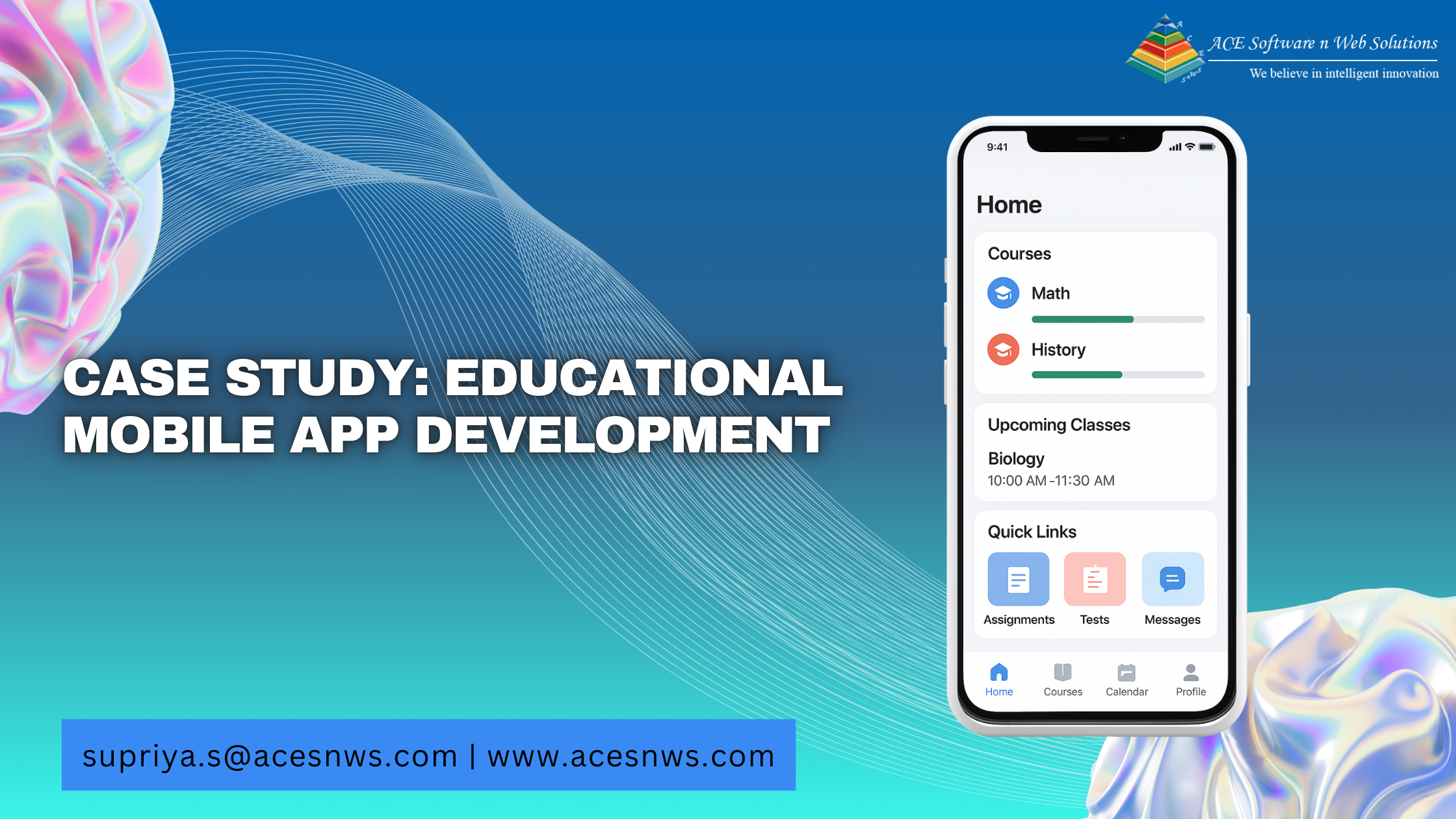
Case Study: Educational Mobile App Development
Case Study: Educational Mobile App Development Transforming Student Learning & Engagement
Introduction
The education industry is rapidly evolving with the adoption of digital technologies. Institutions are moving beyond traditional classrooms to offer smart, flexible, and student-centric learning experiences. One of the most impactful digital transformations in this space is mobile app development for education, enabling students to access learning resources, track progress, and manage academic activities from a single platform.
This case study highlights how a custom educational mobile app development solution helped an education provider streamline multiple student-centric functionalities, improve engagement, and enhance learning outcomes.
Client Overview
The client is a mid-sized educational institution offering undergraduate and professional certification programs. With students spread across multiple locations, the institution faced challenges in managing academic communication, tracking student progress, and providing a unified digital experience.
They approached us with a clear objective:
To build a scalable, user-friendly educational mobile application that could act as a single digital companion for students.
Challenges Faced by the Institution
The education industry is undergoing rapid digital transformation, yet many institutions continue to rely on fragmented systems and manual processes to manage student-related activities. The client, a growing educational institution with multiple academic programs and a diverse student base, faced several operational and academic challenges that directly impacted student experience, faculty efficiency, and administrative control.
Before adopting a mobile solution, the institution struggled with:
- Disconnected systems for attendance, assignments, and assessments
- Limited student engagement outside classroom hours
- Manual tracking of academic progress
- Inefficient communication between students, faculty, and administration
- Lack of real-time access to learning materials
These challenges directly impacted operational efficiency and student satisfaction.
1. Fragmented Academic Systems
The institution was using multiple disconnected platforms for attendance tracking, assignment submissions, exam management, and communication. Some activities were handled through spreadsheets, others through emails or standalone portals. This lack of integration resulted in:
- Duplicate data entry across systems
- Frequent data inconsistencies and errors
- No single source of truth for student information
Students had to log in to multiple platforms to access different services, which created confusion and reduced adoption of digital tools.
2. Limited Student Visibility into Academic Progress
One of the biggest challenges was the absence of real-time academic tracking for students. Attendance records, internal assessments, and exam results were updated manually and shared after significant delays. As a result:
- Students were unaware of their attendance shortages until it was too late
- Academic performance trends were not visible
- Students could not proactively improve weak subjects
This lack of transparency negatively affected student accountability and learning outcomes.
3. Low Student Engagement Outside the Classroom
Despite having qualified faculty and structured courses, student engagement was largely limited to classroom hours. There was no centralized digital platform to support continuous learning. The institution faced:
- Poor engagement with study materials after lectures
- Limited access to recorded sessions or revision content
- Minimal interaction between students and faculty beyond classes
In an era of digital-first learning, this gap reduced the overall effectiveness of education delivery.
4. Inefficient Communication Channels
Communication between students, faculty, and administration was highly unstructured. Important updates such as timetable changes, exam notifications, assignment deadlines, and announcements were shared via notice boards, emails, or messaging apps. This resulted in:
- Missed or delayed communications
- Information overload across multiple channels
- No confirmation of message receipt
Students often complained about missing critical updates, leading to frustration and operational inefficiencies.
5. Manual Administrative Workload
Administrative teams spent a significant amount of time managing routine academic tasks manually. Attendance reconciliation, report generation, fee tracking, and student queries required constant human intervention. This led to:
- High dependency on administrative staff
- Increased chances of human error
- Delays in reporting and decision-making
The institution struggled to scale operations without proportionally increasing manpower.
6. Lack of Centralized Learning Content Access
Educational content such as lecture notes, PDFs, videos, and assignments were shared through different mediums, including emails, cloud drives, and messaging apps. This caused:
- Difficulty in locating the latest study materials
- Version control issues
- Poor content utilization by students
Students lacked a structured and organized learning repository accessible anytime, anywhere.
7. Growing Expectations from Digital-Native Students
Modern students expect seamless digital experiences similar to consumer apps they use daily. The institution realized that without investing in educational mobile app development, it risked:
- Lower student satisfaction and retention
- Reduced brand perception as a technology-driven institution
- Losing competitive advantage to digitally advanced EdTech players
Meeting these expectations became critical for long-term growth.
8. Need for Scalability and Future Readiness
With plans to expand courses and onboard more students, the existing systems were not scalable. The institution needed a custom mobile app development solution that could:
- Scale with increasing users
- Integrate future technologies like AI-driven analytics
- Support online and hybrid learning models
Without a strong mobile-first foundation, future digital initiatives would remain limited.
This detailed breakdown strongly positions the need for mobile app development in the education industry and naturally sets up the transition to the solution section.
Solution: Custom Educational Mobile App Development
Our team designed and delivered a custom mobile app development solution specifically tailored for the education industry. The app was developed for both Android and iOS platforms, ensuring maximum accessibility.
Technology Stack Used
- Mobile App Development: Flutter (cross-platform)
- Backend: Node.js & REST APIs
- Database: PostgreSQL
- Cloud Hosting: AWS
- Security: Role-based access and encrypted data handling
This ensured scalability, performance, and data security for the education ecosystem.
Implementation Approach
Our mobile app development process followed a structured and agile approach:
- Requirement analysis with academic stakeholders
- UX/UI design focused on student usability
- Modular development for future scalability
- Rigorous testing across devices
- App store deployment and post-launch support
Results & Business Impact
The implementation of a custom educational mobile app development solution delivered significant improvements across academic operations, student engagement, and administrative efficiency. Within the first six months of launch, the institution experienced tangible, measurable results that justified its investment in mobile app development and positioned it as a digitally progressive education provider.
The educational mobile app delivered measurable results within six months:
- 40% increase in student engagement
- 60% reduction in manual administrative work
- Improved student attendance and assignment completion rates
- Faster communication and transparency
- Positive feedback from students and faculty
The institution also gained a competitive advantage by positioning itself as a digitally advanced education provider.
1. Significant Increase in Student Engagement
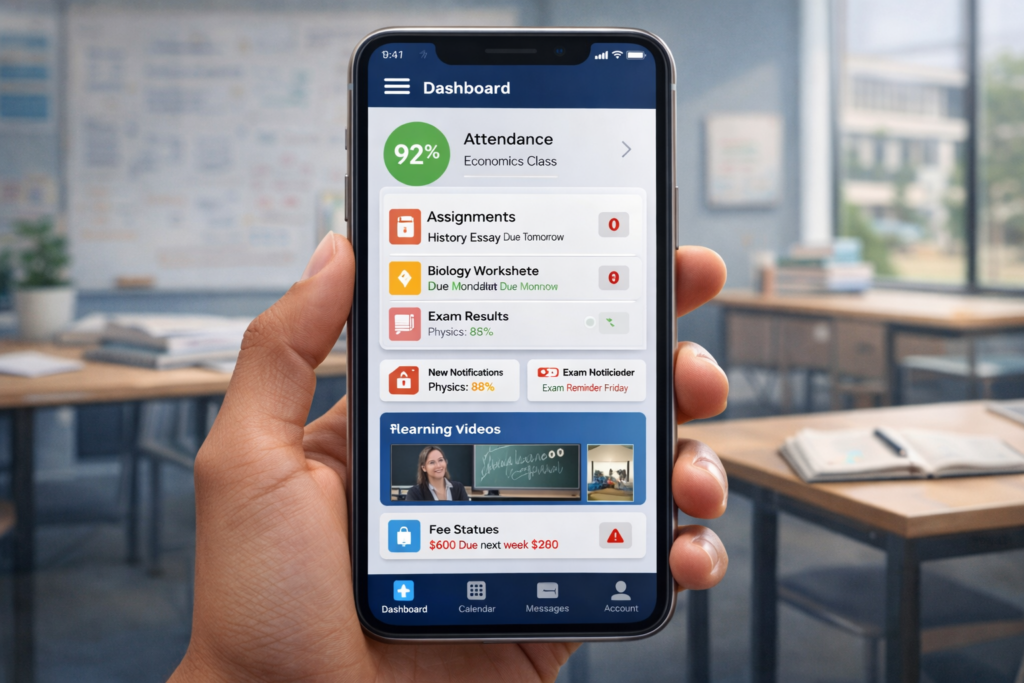
The mobile app transformed how students interacted with academic content and institutional processes. With instant access to schedules, assignments, learning materials, and notifications, students began using the app as their primary academic tool.
Impact observed:
- Daily active student usage increased by over 40%
- Higher participation in quizzes, assignments, and revision activities
- Improved consistency in class attendance due to real-time tracking
Students reported feeling more connected to their academic journey, as all critical information was accessible in one place.

2. Improved Academic Performance & Accountability
Real-time visibility into attendance, grades, and course progress empowered students to take ownership of their performance. Instead of receiving delayed updates, students could instantly identify gaps and act early.
Results achieved:
- Reduction in attendance-related academic penalties
- Improved internal assessment scores across multiple courses
- Higher assignment submission rates before deadlines
This transparency fostered a culture of accountability and continuous improvement among students.
3. Streamlined Administrative Operations
By automating core academic processes through mobile app development, the institution significantly reduced its dependency on manual work. Tasks that once required hours of coordination were now handled digitally.
Operational improvements included:
- Automated attendance consolidation and reporting
- One-click generation of academic and compliance reports
- Reduced administrative workload by nearly 60%
This allowed administrative staff to focus on strategic initiatives rather than repetitive tasks.
4. Faster & More Effective Communication
The integrated notification and messaging system ensured that critical updates reached students instantly and reliably. Push notifications replaced scattered communication channels and eliminated information gaps.
Business impact:
- Near-zero missed announcements or exam notifications
- Faster response times between faculty and students
- Increased trust due to transparent and timely communication
The institution gained better control over communication while students benefited from clarity and consistency.
5. Centralized Access to Learning Resources
The mobile app created a structured digital learning environment where all study materials were organized by course and subject. Students could access content anytime, whether on campus or remotely.
Key outcomes:
- Increased usage of recorded lectures and revision materials
- Improved preparation for exams and assessments
- Higher satisfaction scores related to learning accessibility
This supported hybrid and self-paced learning models, critical in modern education.
6. Enhanced Faculty Productivity
Faculty members benefited from simplified academic workflows and reduced administrative burden. Attendance marking, assignment evaluation, and communication became more efficient through the app.
Faculty-level benefits included:
- Faster assignment reviews and feedback delivery
- Reduced classroom administrative overhead
- Better insights into student performance trends
This enabled educators to focus more on teaching quality and mentorship.
7. Data-Driven Academic Decision Making
The analytics and reporting features built into the mobile app provided administrators with actionable insights. Academic leaders could track trends at both student and course levels.
Strategic advantages gained:
- Early identification of at-risk students
- Data-backed curriculum improvements
- Smarter resource allocation
This marked a shift from reactive to proactive academic management.
8. Increased Student Satisfaction & Retention
A seamless mobile-first experience aligned with modern student expectations. The institution observed a noticeable improvement in student feedback and retention indicators.
Measurable outcomes:
- Higher student satisfaction survey scores
- Improved student retention across semesters
- Stronger word-of-mouth referrals
The mobile app became a differentiator in student admissions and branding.
9. Scalable & Future-Ready Digital Foundation
The custom mobile app development architecture allowed the institution to scale without additional operational complexity. The solution was designed to support future integrations such as AI-driven recommendations, advanced analytics, and virtual classrooms.
Long-term impact:
- Easy onboarding of new students and courses
- Readiness for digital exams and online learning expansion
- Lower technology upgrade costs
Summary of Results
By investing in mobile app development for the education industry, the institution achieved:
- Better student engagement and performance
- Reduced operational costs
- Stronger institutional branding
- Sustainable digital transformation
This case study highlights how a well-executed educational mobile app development solution delivers not just technical success, but real, measurable business and academic impact.
Why Mobile App Development is Critical for the Education Industry
This case study clearly demonstrates how mobile app development for education enables institutions to:
- Centralize academic processes
- Enhance learning accessibility
- Improve student retention
- Enable data-driven academic decisions
With the rise of EdTech, custom educational app development is no longer optional—it is a strategic necessity.
Conclusion
A well-planned educational mobile app development solution can transform how institutions interact with students, manage academics, and deliver value. By combining intuitive design, scalable technology, and education-focused features, this mobile app empowered students to take control of their learning journey.
If you are looking to invest in custom mobile app development for the education industry, this case study serves as a proven example of how technology can create real impact.