
Case Study: Construction Industry Digital Transformation
Construction Industry Digital Transformation: A Case Study on Software, Mobile App, and AI Adoption
Introduction: When Construction Growth Outpaced Systems
The construction industry has always been execution-heavy—tight timelines, multiple vendors, on-site teams, compliance pressure, and razor-thin margins. In this case study, we explore how a mid-sized construction company achieved complete digital transformation by adopting custom software development, mobile app development, and AI-driven analytics to fix operational chaos and unlock scalable growth.
Despite handling projects worth ₹50–₹80 crore annually, the company struggled with cost overruns, inaccurate project reporting, delayed decision-making, and poor site-level visibility. The root cause wasn’t lack of effort—it was disconnected systems and manual processes.
This blog walks through the real situations, why they failed, and how digital transformation in construction solved them—step by step.
Business Challenges Before Digital Transformation
1. Project Cost Estimation Was Guesswork, Not Science
Each new project started with Excel-based cost estimation. BOQs were prepared manually, historical data was scattered, and vendor pricing was outdated. Project managers relied heavily on experience rather than data.
Real Impact:
- Estimates varied widely between teams
- Frequent budget revisions during execution
- Profit margins eroded by 8–12%
Why It Failed:
Manual estimation couldn’t factor in historical overruns, vendor trends, or location-specific risks. This is a common issue in construction companies that haven’t adopted custom construction software.
2. On-Site Attendance Was Inaccurate and Manipulated
Attendance was marked on paper registers or WhatsApp messages. Supervisors often filled entries in bulk at day’s end.
Real Impact:
- Ghost workers on payroll
- Labour cost leakage of ₹3–₹5 lakh per month
- No real-time workforce visibility
Why It Failed:
No geo-validation, no time stamping, and no integration with payroll. This is where mobile app development for construction sites becomes critical.
3. Site Updates Were Delayed and Incomplete
Daily Progress Reports (DPRs) were shared late, often missing photos, quantities, or safety updates. Management discovered delays only during review meetings.
Real Impact:
- Decisions made on outdated data
- Escalation of small delays into major slippages
- Client dissatisfaction
Why It Failed:
There was no centralized construction project management system with real-time site reporting.
4. Reporting Was Reactive, Not Predictive
Weekly and monthly reports were manually compiled from multiple sources—Excel, emails, WhatsApp, and site registers.
Real Impact:
- 3–4 days spent only on reporting
- Errors and mismatched numbers
- No early warning signals
Why It Failed:
Traditional tools cannot analyze patterns. The absence of AI in construction project management meant no predictive insights.
The Digital Transformation Strategy
The company partnered with a custom software development and mobile app development firm to design a unified construction technology platform.
Phase 1: Construction Project Management Software
A centralized web-based system was developed to manage:
- Project planning and scheduling
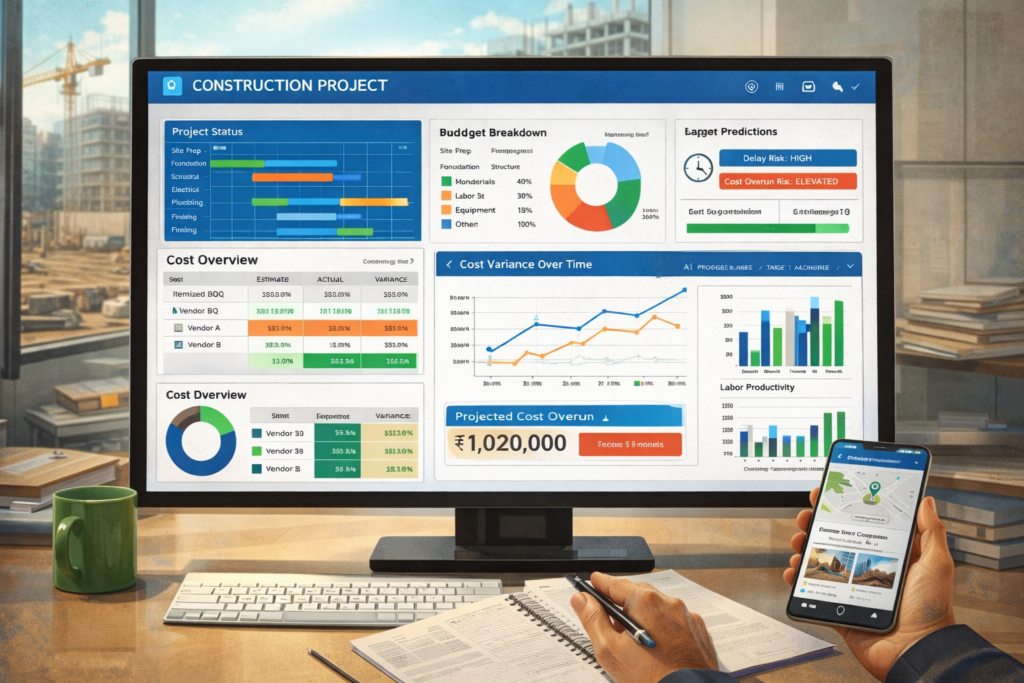
- Cost estimation and budget tracking
- Vendor and material management
- Centralized reporting
How It Fixed the Problem:
Historical project data was digitized and structured. New project estimates now referenced:
- Past project costs
- Vendor performance
- Location-specific data
This significantly improved construction cost estimation accuracy.
Phase 2: Mobile App Development for On-Site Teams
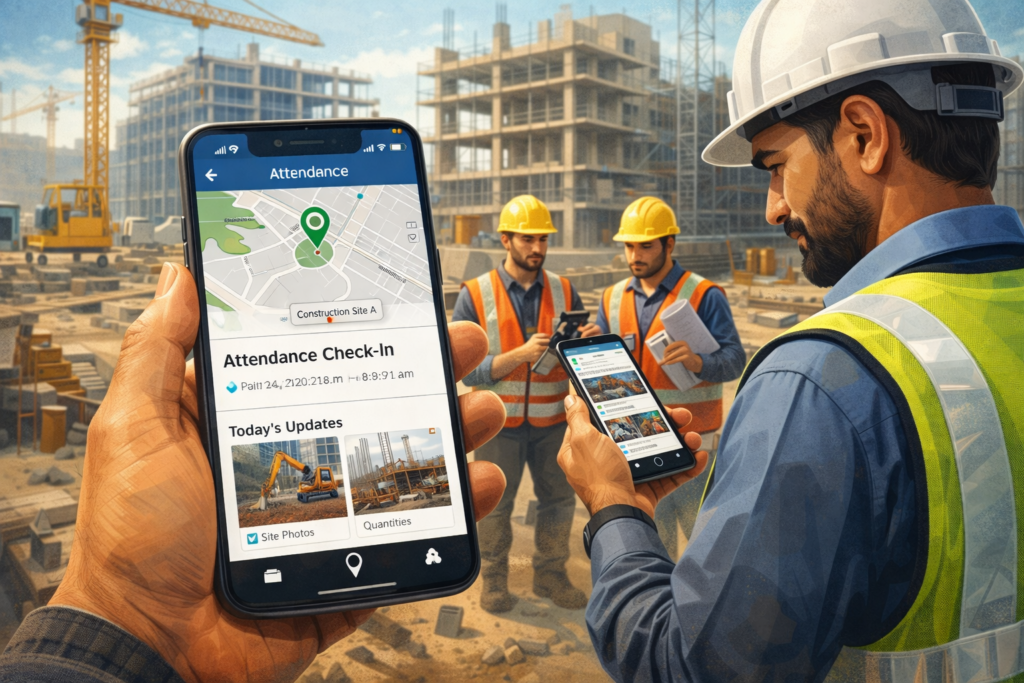
A dedicated construction Geofencing mobile app was introduced for site engineers, supervisors, and contractors.
Key Mobile App Features:
- Geo-fenced attendance with time stamps
- Daily site updates with photos and videos
- Quantity tracking and work progress
- Safety incident reporting
How It Fixed the Problem:
Attendance fraud dropped immediately. Payroll became data-driven. Site updates were uploaded in real time, improving visibility and accountability.
This is a classic example of how mobile app development transforms construction site operations.

Phase 3: AI-Driven Analytics and Predictive Reporting
Once data started flowing consistently, AI and machine learning models were introduced.
AI Capabilities Implemented:
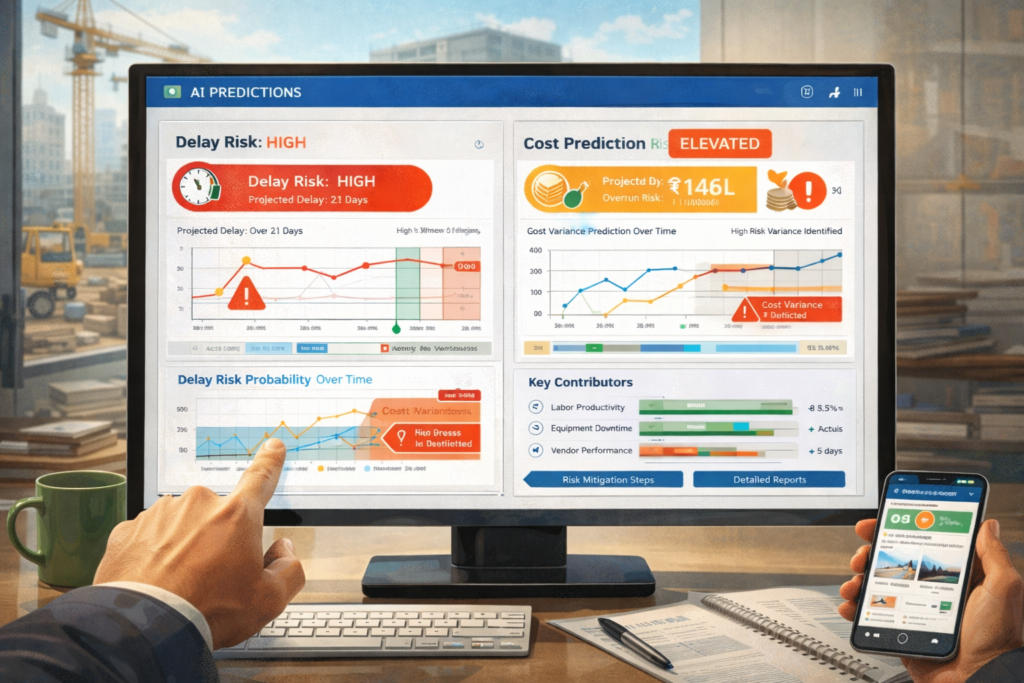
- Cost overrun prediction
- Delay risk forecasting
- Labour productivity analysis
- Vendor performance scoring
How It Fixed the Problem:
Instead of asking “Why did this go wrong?”, management now asked “What will go wrong next week?”
This shift from reactive to predictive management is the true power of AI in construction digital transformation.
Results After Digital Transformation
Cost Control and Profitability
- Estimation accuracy improved by 20–25%
- Cost overruns reduced by 30%
- Improved margin predictability
Site Productivity
- 100% real-time attendance tracking
- Reduced labour leakage
- Faster issue resolution
Reporting and Decision-Making
- Reports generated instantly
- Single source of truth
- Faster executive decisions
Client Satisfaction
- Transparent progress sharing
- Fewer disputes
- Improved trust and repeat business
Cost Estimation for Digital Transformation
A common question in construction digital transformation is cost. Below is a realistic estimate:
Approximate Investment Breakdown:
- Custom Construction Software Development: ₹6–10 lakh
- Mobile App Development (Android/iOS): ₹4–6 lakh
- AI & Analytics Module: ₹5–8 lakh
- Integration, Training & Support: ₹2–3 lakh
Total Investment: ₹17–27 lakh
ROI Timeline: 6–9 months
Compared to recurring losses from inefficiencies, this investment proved highly economical.
Why Custom Development Worked Better Than Off-the-Shelf Tools
Generic tools failed earlier because:
- They didn’t match site workflows
- They lacked Indian construction compliance support
- They couldn’t scale with business complexity
Custom software development for construction allowed:
- Tailored workflows
- Seamless mobile-web integration
- AI models trained on company-specific data
Conclusion: Digital Transformation Is No Longer Optional
This case study clearly shows that digital transformation in the construction industry is not about technology—it’s about control, visibility, and predictability.
By combining construction project management software, mobile app development, and AI-powered analytics, the company transformed:
- Chaos into clarity
- Delays into foresight
- Cost overruns into controlled margins
For construction companies still relying on spreadsheets, WhatsApp, and manual registers, the question is no longer “Should we digitize?”—it’s “How much are we losing by not doing it?”