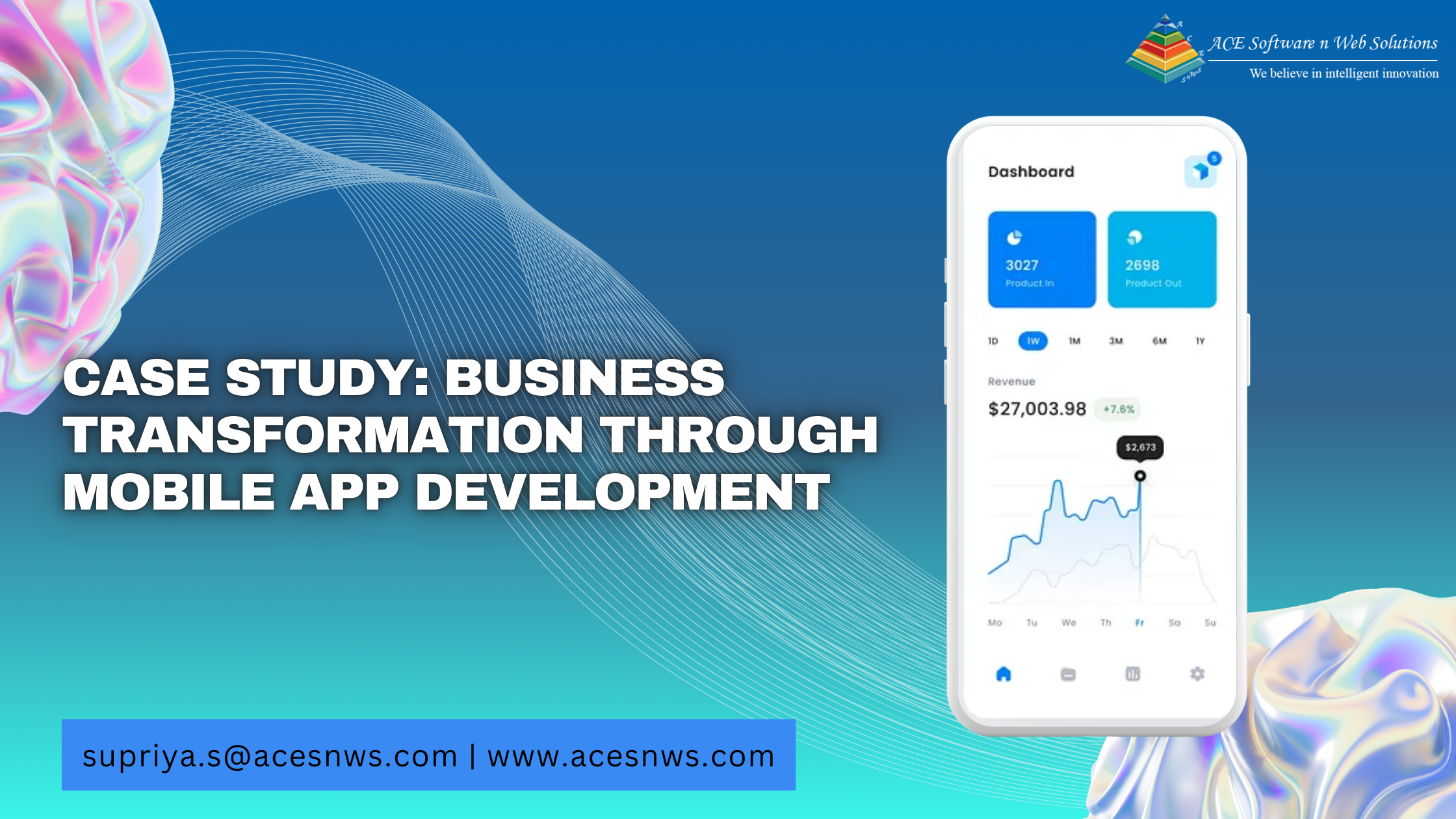
Case Study: Business Transformation Mobile App Development
Client Overview
A fast-growing SME operating in distribution and service management was facing challenges in managing daily operations across sales, inventory, finance, and management reporting. Like many SMEs, the business relied on spreadsheets, emails, and disconnected desktop tools. This resulted in delayed decision-making, limited visibility, and operational inefficiencies.
The leadership team aimed to adopt mobile app development as a strategic step toward business transformation—enabling easy accessibility, real-time data, and centralized reporting across multiple business functions.
Business Challenges
Despite steady growth, the SME was struggling to manage its expanding operations due to fragmented systems and manual processes. The absence of a unified mobile app development solution created operational blind spots and slowed down decision-making. Each department operated in silos, leading to inefficiencies that directly impacted productivity, profitability, and scalability.
The SME encountered several operational bottlenecks:
- Disconnected business functions: Sales, inventory, and finance data were maintained in separate systems.
- Manual reporting: Management reports were prepared weekly using spreadsheets, leading to errors and delays.
- Limited accessibility: Key stakeholders could not access real-time data while on the move.
- Low productivity: Field teams depended on phone calls and emails to update task statuses.
- Scalability concerns: Existing tools were not designed to support business growth.
1. Disconnected Business Functions
Sales, inventory, finance, and management reporting were handled using separate tools and spreadsheets. There was no real-time synchronization between departments, causing frequent data mismatches. For example, the sales team often committed orders without visibility into actual stock availability, while the finance team struggled to reconcile invoices with order records. This lack of integration made cross-functional coordination difficult and increased dependency on manual follow-ups.
2. Heavy Dependence on Manual Processes
Most operational activities, including order entries, expense tracking, approvals, and reporting, were performed manually. Employees spent excessive time updating spreadsheets and sending email confirmations. These repetitive tasks not only reduced productivity but also increased the risk of human errors, duplicate entries, and missing data. The management team had limited confidence in reports generated through manual consolidation.
3. Delayed and Inaccurate Reporting
Business performance reports were generated weekly or monthly by collecting data from multiple sources. By the time reports reached decision-makers, the data was already outdated. There was no real-time visibility into key metrics such as daily sales, outstanding payments, or inventory turnover. This delay restricted proactive decision-making and forced leadership to rely on assumptions rather than accurate insights.
4. Limited Accessibility to Business Data
Key stakeholders and field executives could access business information only through desktop systems or office-based tools. When working remotely or traveling, they depended on phone calls and messages to get updates. This lack of mobile accessibility slowed approvals, delayed responses to customer inquiries, and impacted overall operational agility—highlighting the need for a robust enterprise mobility solution.
5. Low Field Team Productivity
Sales and operations teams working on the ground lacked a structured system to update task statuses, orders, or customer interactions in real time. Updates were often shared at the end of the day, leading to data gaps and delayed actions. Without a mobile-first approach, managers had limited visibility into field activities, affecting planning and performance evaluation.
6. Lack of Centralized Management Dashboard
The leadership team had no single dashboard to monitor business performance across departments. KPIs such as revenue trends, order fulfillment rates, and payment cycles were reviewed manually. The absence of centralized, real-time dashboards made it difficult to identify issues early or measure operational efficiency accurately.
7. Scalability and Growth Limitations
As the business expanded, existing tools failed to support increased transaction volumes and users. Adding new processes or teams required additional manual effort and tool customization. The lack of a scalable custom mobile app development approach restricted growth and increased operational complexity.
This growing set of challenges made it clear that the SME required a comprehensive business transformation mobile app development solution—one that could unify operations, automate workflows, provide real-time reporting, and enable easy accessibility for all stakeholders.
The company needed a custom mobile app development solution that could unify business processes while remaining easy to use for non-technical users.
Solution: Custom Mobile App Development for Business Transformation
A business transformation mobile app was designed and developed to digitize and integrate core SME operations. The solution focused on simplicity, role-based access, and actionable insights.
This enterprise mobility solution ensured that all stakeholders—from field executives to business owners—could access accurate data anytime, anywhere.
Technology Approach
The mobile app development strategy focused on scalability and security:
- Cross-platform mobile app development (Android & iOS)
- Secure API integration with existing systems
- Cloud-based backend for real-time synchronization
- Role-based access control for data security
- User-friendly UI designed for non-technical SME users
The solution aligned with the client’s long-term digital transformation for SMEs roadmap.
Business Impact & Results
The implementation of the business transformation mobile app development solution delivered tangible and measurable improvements across the SME’s operations. By replacing fragmented tools with a unified mobile platform, the organization achieved operational efficiency, improved visibility, and stronger decision-making capabilities.
Within six months of implementation, the SME experienced measurable improvements:
- 40% reduction in manual work through automated workflows
- Real-time reporting replaced delayed spreadsheet-based analysis
- Improved decision-making due to live dashboards and alerts
- Higher productivity among field and operations teams
- Better customer experience through faster order processing
The mobile app became a central business tool rather than just a supporting system.
1. Significant Reduction in Manual Effort
Automating routine workflows such as order entry, approvals, invoicing, and data synchronization drastically reduced dependence on spreadsheets and emails. Employees no longer needed to re-enter the same data across multiple systems. This resulted in a 40% reduction in manual administrative work, allowing teams to focus on revenue-generating and strategic activities instead of repetitive tasks. The overall accuracy of business data improved, minimizing rework and operational delays.

2. Real-Time Visibility Across Business Functions
With centralized data and live synchronization, all departments gained instant access to updated information. Sales teams could view stock availability in real time, finance teams could track outstanding payments instantly, and management could monitor daily business performance through mobile dashboards. This real-time visibility eliminated guesswork and enabled faster responses to operational issues, significantly improving business agility.
3. Faster and More Informed Decision-Making
The mobile app’s integrated reporting and analytics transformed decision-making. Instead of waiting for weekly or monthly reports, leadership could access real-time KPIs such as sales trends, order fulfillment rates, inventory movement, and cash flow. This shift from reactive to data-driven decision-making allowed the management team to identify bottlenecks early and take corrective actions immediately.
4. Improved Field Team Productivity and Accountability
Field executives and operational staff were empowered with mobile-first tools to update activities, orders, and customer interactions instantly. Real-time updates reduced communication gaps and eliminated end-of-day reporting delays. Managers gained better visibility into field operations, enabling improved planning, performance tracking, and accountability. As a result, field productivity increased, and task completion cycles became faster and more structured.

5. Enhanced Customer Experience
With faster order processing, accurate inventory visibility, and timely invoicing, customer interactions became smoother and more reliable. Sales teams could provide accurate delivery timelines, while finance teams ensured quicker billing and payment follow-ups. This improved responsiveness strengthened customer trust and contributed to higher customer retention and satisfaction levels.
6. Centralized Management Dashboards
The introduction of a centralized management dashboard became a game-changer for leadership. Executives could monitor key business metrics across departments from a single mobile interface. Visual dashboards simplified performance tracking, highlighted trends, and supported strategic planning. This level of transparency enabled leadership to align operational activities with business goals more effectively.

7. Scalability and Future-Ready Operations
The custom mobile app development architecture was designed to scale with business growth. New users, workflows, and modules could be added without disrupting existing operations. The solution supported future enhancements such as advanced analytics, AI-driven insights, and deeper system integrations. This ensured the SME was not only optimized for current operations but also prepared for long-term digital growth.
8. Improved ROI on Digital Investment
By consolidating multiple tools into a single enterprise mobility solution, the SME reduced software maintenance costs and manual overhead. Faster operations, improved productivity, and better decision-making contributed to a strong return on investment. The mobile app quickly evolved from a support tool into a core business asset driving operational excellence.
Overall Outcome
The mobile app development-led business transformation enabled the SME to move from fragmented, manual operations to a streamlined, data-driven, and scalable digital ecosystem. The organization gained control, clarity, and confidence in its daily operations—proving that the right mobile technology can deliver enterprise-level efficiency even for small and medium businesses.
Why Mobile App Development is a Game-Changer for SMEs?
This case study highlights how mobile app development enables SMEs to compete with larger enterprises by:
- Simplifying complex business processes
- Providing easy accessibility to business data
- Offering real-time reporting and analytics
- Supporting scalable and future-ready operations
Unlike off-the-shelf software, custom mobile app development ensures alignment with unique business workflows and growth plans.
Conclusion
Business transformation is no longer limited to large enterprises. With the right mobile app development strategy, SMEs can unify business functions, improve visibility, and make data-driven decisions effortlessly.
This case study demonstrates that investing in a business transformation mobile app is not just about technology—it’s about empowering teams, enhancing efficiency, and enabling sustainable growth.
If your SME is struggling with disconnected tools, manual reporting, or limited accessibility, a tailored mobile app development solution could be the catalyst for your next phase of growth.