
How IoT Transformed Manufacturing Inventory Management: Case Study
Introduction: The Hidden Cost of Poor Inventory Management
In today’s competitive manufacturing landscape, inventory is not just a stockpile—it’s a critical financial asset. Yet, most manufacturing companies still struggle with:
- Stock mismatches
- Production delays due to material shortages
- Excess inventory blocking working capital
- Manual errors and lack of real-time visibility
These inefficiencies silently create profit leakages.
This case study explores how an IoT-based inventory management system helped a mid-sized manufacturing company eliminate inefficiencies, improve accuracy, and unlock real-time operational intelligence.
About the Client
A mid-sized manufacturing company in India dealing in industrial components faced recurring challenges:
- Frequent stock-outs during peak production
- Over-ordering of slow-moving materials
- Manual inventory tracking using spreadsheets
- Lack of integration between inventory and production
Despite using a traditional ERP, they lacked real-time visibility and actionable insights.
The Challenge: How Poor Inventory Management Was Draining Profits
Despite having an ERP system in place, the company was operating with limited visibility, delayed data, and manual dependencies. Inventory was treated as a static record rather than a dynamic, real-time operational asset.
This resulted in continuous profit leakages, production inefficiencies, and missed business opportunities.
Core Problems Identified
1. Lack of Real-Time Inventory Visibility
Inventory data was updated manually at the end of the day or sometimes even later. This meant:
- Production teams were making decisions on outdated stock data
- Purchase teams were ordering materials based on assumptions rather than actual consumption
- Management had no live dashboard to track stock movement
Result: Decisions were always reactive, never proactive.
2. High Dependency on Manual Processes
All inward/outward entries, stock counts, and adjustments were manually recorded.
- Frequent human errors in data entry
- Mismatch between physical stock and system stock
- Time-consuming stock audits disrupting operations
Result: Loss of accuracy and operational inefficiency.
3. No Demand Forecasting or Smart Reordering
The company followed a basic min-max or ad-hoc ordering system.
- No analysis of historical consumption trends
- No forecasting based on production plans
- Overstocking of slow-moving items
Result: Working capital was unnecessarily blocked.
4. No Visibility into Shop Floor Movement (WIP)
Once raw materials were issued to production:
- There was no tracking of how much was consumed
- No clarity on work-in-progress inventory
- High chances of material wastage or pilferage
Result: Invisible losses within production.
Real Business Impact: Scenarios That Caused Major Losses
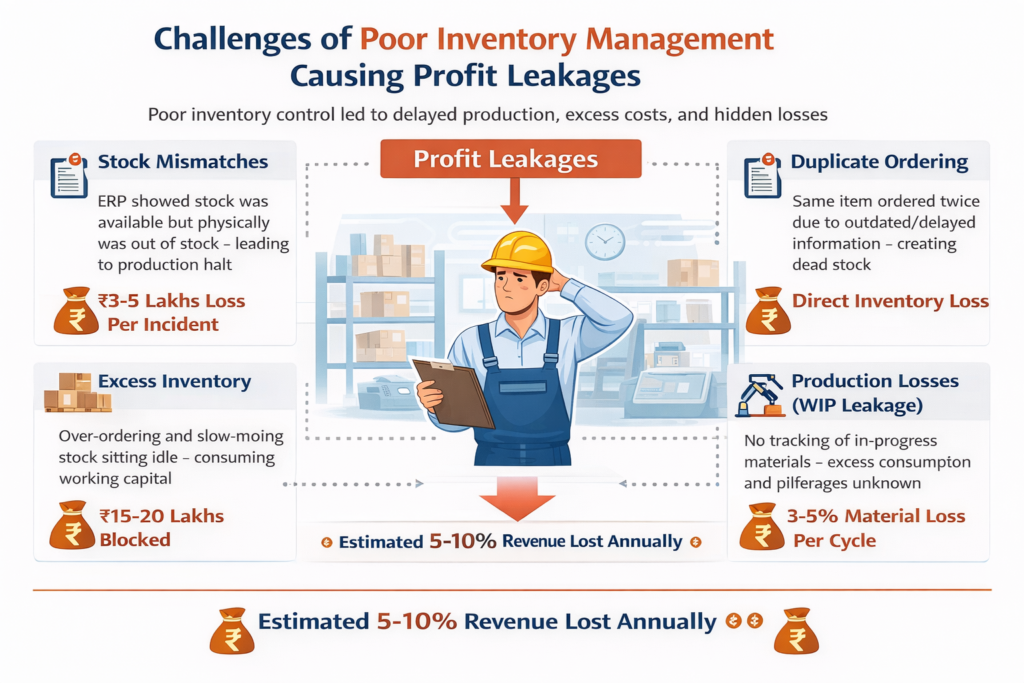
Scenario 1: Production Halt Due to Stock Mismatch
A critical raw material showed available in the ERP, but physically it was already consumed.
- Production line stopped for 6–8 hours
- Urgent procurement at higher cost (20–30% premium)
- Missed delivery deadline → penalty from client
Estimated Loss: ₹3–5 Lakhs (in a single incident)
Scenario 2: Excess Inventory Blocking Working Capital
Due to lack of consumption insights:
- Bulk purchase of a slow-moving component
- Material remained unused for 4–6 months
- Warehouse space occupied unnecessarily
Impact: ₹15–20 Lakhs blocked + storage & handling cost
Scenario 3: Duplicate Ordering Due to Poor Visibility
Purchase team assumed stock was low due to delayed updates.
- Same material ordered twice within a short period
- Overstock led to dead inventory
- Some materials became obsolete due to design changes
Impact: Direct inventory loss + write-offs
Scenario 4: Hidden Losses in Production (WIP Leakage)
Materials issued to production were not tracked properly.
- Excess material consumption went unnoticed
- No accountability at department level
- Scrap and wastage not recorded accurately
Impact: 3–5% material loss per cycle (huge over time)
Scenario 5: Audit & Compliance Issues
During audits:
- Stock mismatches required manual reconciliation
- Finance team struggled with valuation accuracy
- Increased audit time and compliance risks
Impact: Operational stress + potential financial discrepancies
The Solution: IoT-Based Smart Inventory System
To address these challenges, an IoT-powered inventory management solution was implemented with the following architecture:
1. Smart Data Capture Layer
- RFID & Barcode Scanners
- IoT Sensors on racks and bins
- Smart shelves with weight sensors
2. Connectivity Layer
- Industrial IoT Gateway
- Wi-Fi / 4G / 5G data transmission
3. Cloud & Processing Layer
- Real-time data collection
- Edge processing for quick decisions
- Cloud analytics engine
- AI/ML-based forecasting
4. Application Layer
- Live inventory dashboard
- Automated alerts & notifications
- ERP integration
How the System Works (End-to-End Flow)
- Material Entry
Raw materials are tagged with RFID/barcodes upon arrival. - Real-Time Tracking
Sensors track movement across warehouse and production floor. - Data Transmission
IoT gateways send data to the cloud instantly. - Processing & Analytics
System analyzes consumption patterns and stock levels. - Automated Actions
- Low stock alerts
- Reorder triggers
- Stock adjustments
- User Interface
Management views real-time dashboards and reports.
Key Features Implemented
🔹 Real-Time Inventory Visibility
Know exactly what stock is available, where, and in what quantity.
🔹 Automated Stock Updates
No manual entries—everything updates automatically.
🔹 Smart Reorder System
AI-driven reorder levels based on consumption trends.
🔹 WIP Tracking
Track material movement within production in real-time.
🔹 ERP Integration
Seamless sync with existing business systems.
Results: Measurable Business Impact
The implementation of the IoT-based inventory management system did not just improve operational visibility—it fundamentally transformed the company’s ability to control costs, optimize production, and make data-driven decisions.
Within the first few months of deployment, the organization began experiencing measurable improvements across inventory accuracy, production efficiency, procurement planning, and overall profitability.
The transformation impacted multiple departments simultaneously, including:
- Procurement
- Warehouse Management
- Production Planning
- Operations
- Finance
- Quality Control
- Senior Management
1. 99% Inventory Accuracy Achieved
Before implementation, the company faced frequent mismatches between physical stock and ERP records due to delayed manual updates and human errors.
After IoT deployment:
- Every inward and outward material movement was automatically captured
- RFID/barcode scanning eliminated dependency on manual entries
- Smart shelves and sensors continuously monitored stock levels
Business Impact
✔ Physical stock matched system records almost in real-time
✔ Faster and more reliable production planning
✔ Reduced audit reconciliation efforts dramatically
Operational Impact
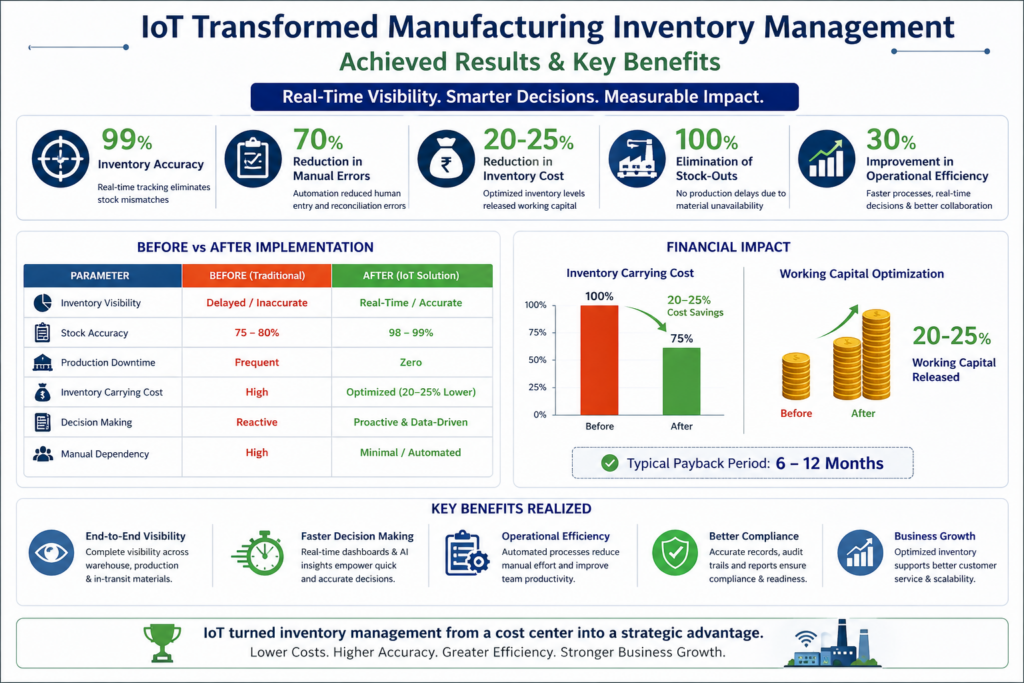
- Inventory accuracy improved from 75–80% to 98–99%
- Manual stock verification time reduced by over 60%
2. 70% Reduction in Manual Errors
Previously, inventory transactions depended heavily on manual data entry.
This resulted in:
- Duplicate entries
- Wrong stock adjustments
- Incorrect material issues
- Delayed updates
After automation:
- IoT devices captured inventory data automatically
- Material movement became digitally traceable
- Real-time synchronization eliminated delayed entries
Business Impact
✔ Reduced operational confusion
✔ Fewer production interruptions
✔ Increased employee productivity
Financial Impact
The company significantly reduced hidden losses caused by inaccurate inventory reporting and manual corrections.
3. 20–25% Reduction in Inventory Carrying Cost
One of the biggest improvements came in inventory optimization.
Before implementation:
- Procurement teams ordered excess materials “just to be safe”
- Slow-moving stock accumulated in warehouses
- Working capital remained blocked unnecessarily
With IoT + analytics:
- Real-time consumption tracking improved forecasting
- Smart reorder points prevented overstocking
- AI-driven insights optimized purchasing cycles
Business Impact
✔ Better utilization of warehouse space
✔ Reduced dead stock accumulation
✔ Improved cash flow management
Financial Impact
- Inventory carrying cost reduced by 20–25%
- Significant working capital released for other business operations
4. Elimination of Production Downtime Due to Material Shortages
Earlier, production teams often discovered material shortages only after production had already started.
This caused:
- Machine idle time
- Emergency purchases at premium rates
- Delayed customer deliveries
After implementation:
- Real-time alerts notified teams before stock reached critical levels
- Automated reorder triggers ensured timely replenishment
- Production planners gained live visibility into inventory status
Business Impact
✔ Smooth production continuity
✔ Improved delivery timelines
✔ Higher customer satisfaction
Operational Impact
- Near-zero unplanned production stoppages due to inventory issues
5. Improved Decision-Making with Real-Time Data
Previously, management decisions relied on historical or delayed reports.
After implementation:
- Leadership accessed live dashboards
- Real-time KPIs became available instantly
- Department-wise inventory insights improved coordination
Business Impact
✔ Faster response to operational issues
✔ Better forecasting and planning
✔ Proactive instead of reactive management
Strategic Impact
The organization shifted from intuition-based operations to data-driven decision-making.
6. Better Visibility Across Warehouse & Production
The system provided end-to-end visibility across:
- Raw materials
- Work-in-progress (WIP)
- Finished goods
- In-transit materials
Business Impact
✔ Improved accountability
✔ Easier material traceability
✔ Reduced wastage and pilferage
7. Faster Audits & Compliance Readiness
Before IoT implementation:
- Audits required extensive manual reconciliation
- Inventory validation consumed significant manpower
After implementation:
- All inventory movement became digitally recorded
- Reports were available instantly
- Audit trails improved transparency
Business Impact
✔ Reduced audit preparation time
✔ Improved compliance readiness
✔ Better financial reporting accuracy
8. Increased Operational Efficiency
The automation of inventory processes significantly reduced dependency on manual coordination between departments.
Improvements Observed
- Faster goods inward processing
- Quicker stock identification
- Improved warehouse productivity
- Better coordination between procurement and production
Overall Efficiency Gain
Operational efficiency improved by approximately 25–30%.
9. Enhanced Customer Satisfaction
Inventory-related delays directly affect delivery commitments.
With improved inventory accuracy and production continuity:
- Customer orders were fulfilled faster
- Delays reduced significantly
- On-time delivery performance improved
Business Impact
✔ Improved client trust
✔ Better customer retention
✔ Enhanced market reputation
10. ROI Achieved Faster Than Expected
Although the company initially viewed IoT implementation as a technology investment, it quickly became evident that it was actually a profit optimization initiative.
Typical ROI Timeline
- Initial improvements visible within 2–3 months
- Full operational ROI achieved within 6–12 months
Overall Transformation Summary
| Parameter | Before IoT | After IoT |
|---|---|---|
| Inventory Accuracy | 75–80% | 98–99% |
| Manual Dependency | High | Minimal |
| Production Delays | Frequent | Rare/Near Zero |
| Inventory Cost | High | Optimized |
| Decision-Making | Reactive | Data-Driven |
| Visibility | Limited | Real-Time |
| Audit Readiness | Time-Consuming | Automated |
Payback Period: Typically within 6–12 months
Why IoT Inventory Systems Are the Future of Manufacturing?
Manufacturers are now shifting from reactive to predictive and intelligent operations.
With IoT, you get:
- Operational transparency
- Data-driven decision-making
- Reduced waste and cost
- Scalable digital transformation
Struggling with inventory inaccuracies or production delays?
Get a free consultation and discover how IoT can eliminate your profit leakages.