
Case Study: Geofencing Mobile App Development
Introduction
In today’s fast-moving industrial environment, organizations in construction and manufacturing face a common challenge—accurately tracking employee attendance across large, dynamic worksites. Manual registers, biometric machines, and spreadsheet-based systems often fail due to site mobility, proxy attendance, and disconnected data.
To address this, our team delivered a Geofencing Mobile App Development solution that transformed how attendance, workforce movement, and site compliance were managed—using location intelligence, automation, and real-time reporting.
This case study highlights how custom mobile app development can solve real operational challenges while improving transparency, productivity, and decision-making.
The Client & Industry Challenge
Our client was a mid-sized enterprise operating in both construction, managing multiple sites and plants across different locations. While their teams were highly skilled, the organization was struggling with several operational inefficiencies due to outdated workforce management practices. These challenges were not only affecting productivity but also increasing operational costs and employee frustration.
The client was a mid-sized construction and manufacturing organization managing multiple project sites simultaneously. Their key pain points included:
- Attendance leakage due to proxy punching
- Difficulty tracking employees across multiple sites
- Delays in payroll processing due to inaccurate data
- No real-time visibility for HR and project managers
- Dependence on manual tools and disconnected software
Traditional attendance systems were not scalable or flexible enough for on-field workers. The client required a mobile app development solution that could automatically verify attendance based on physical presence at the work location.
Attendance Leakage and Proxy Marking
One of the most pressing problems was attendance inaccuracies. The client relied heavily on manual registers and standalone biometric systems, which were easily prone to errors or manipulation. Employees could clock in for one another, and supervisors struggled to verify the authenticity of attendance data. This led to attendance leakage, where payroll was often inflated or disputed. The lack of a reliable system made it difficult to track who was actually present at which site, especially for remote and off-shift employees.
2. Difficulty Tracking Employees Across Multiple Sites
The client operated several construction sites and manufacturing plants simultaneously. Without a centralized system, it was nearly impossible to monitor employee movement across locations in real time. Supervisors had to rely on manual check-ins, phone calls, or spreadsheets to confirm site presence. This not only consumed time but also caused delays in project reporting and daily operational planning.
3. Payroll Delays Due to Inaccurate Data
Inaccurate attendance directly impacted payroll processing. HR teams spent hours reconciling timesheets with physical registers, correcting errors, and following up on missing data. This created delays in salary disbursement, leading to employee dissatisfaction and additional administrative overhead.
4. Lack of Real-Time Visibility for HR and Project Managers
Managers and HR personnel lacked real-time insights into workforce attendance, site occupancy, and employee movement. Decisions related to staffing, resource allocation, and safety compliance were based on outdated reports or assumptions. This not only reduced operational efficiency but also affected overall project timelines and site productivity.
5. Dependence on Manual Tools and Disconnected Systems
The organization’s workforce management ecosystem was fragmented. Attendance, payroll, compliance tracking, and reporting were handled through separate tools, none of which communicated with each other. Data had to be manually consolidated, increasing the risk of human error and making analytics or actionable insights extremely difficult.
6. Operational Challenges Unique to Construction
In addition to general workforce issues, the client faced industry-specific challenges:
- Construction: Employees often worked across multiple project sites with fluctuating schedules. Supervisors needed accurate attendance records to manage site allocations and ensure safety compliance.
These combined challenges created a scenario where traditional attendance and HR tools were insufficient, and the client needed a modern, scalable, and automated solution to bring transparency, accuracy, and efficiency to their workforce management system.

The Solution: Geofencing-Based Mobile App Development
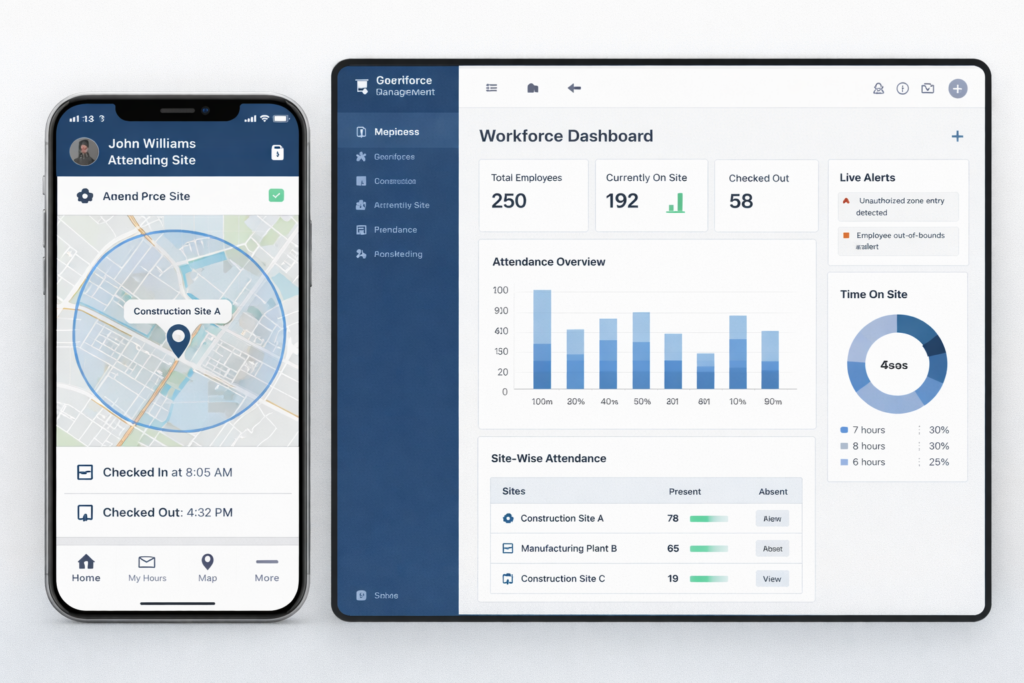
We designed and developed a custom mobile application using geofencing technology. A virtual boundary was created around each construction site or manufacturing plant. Attendance was marked automatically when employees entered or exited the defined geofence using their mobile devices.
Key Features Implemented:
- Geofencing Attendance Tracking
Attendance is logged only when employees are physically present within the site boundary. - Mobile App Development for Android & iOS
Cross-platform mobile app ensuring easy adoption across devices. - Role-Based Access Control
Separate dashboards for employees, supervisors, HR, and management. - Real-Time Attendance Dashboard
Live visibility of workforce presence across all locations. - Offline Mode with Auto Sync
Ensures uninterrupted tracking even in low-network zones. - Integration with Payroll & HR Systems
Seamless data flow to eliminate manual reconciliation.
This enterprise mobile app development approach ensured accuracy, automation, and scalability.
Additional Use Cases Beyond Attendance
While attendance tracking was the primary requirement, the geofencing mobile app unlocked several additional business benefits:
- Work Hours Validation for contract and shift-based labor
- Site Entry & Exit Monitoring for safety compliance
- Asset & Supervisor Movement Tracking
- Restricted Zone Alerts for unauthorized access
- Project-Based Workforce Allocation
- Audit-Ready Attendance Reports
This demonstrates how mobile app development services can extend beyond a single use case to become a core operational system.
Technology Stack Used
- Frontend: Android & iOS Mobile App Development
- Backend: Secure Cloud-Based APIs
- Database: Scalable Relational Database
- GPS & Location Services for Geofencing
- Role-Based Web Admin Panel
The architecture was designed for performance, security, and future enhancements.
Business Impact & Results
After implementing the geofencing-based mobile app, the client experienced significant improvements in workforce management, operational efficiency, and overall business performance. The solution not only resolved long-standing issues but also enabled smarter decision-making, higher productivity, and cost savings. Here’s a detailed breakdown of the impact, after deployment, the client experienced measurable improvements within the first three months:
- 95% reduction in attendance fraud
- 40% faster payroll processing
- Real-time workforce visibility across all sites
- Improved compliance and audit readiness
- Higher employee accountability and discipline
The custom mobile app development solution quickly became a critical operational tool for both construction and manufacturing teams.
1. 95% Reduction in Attendance Fraud
The automatic geofencing feature ensured that attendance was marked only when employees physically entered the site boundaries. This virtually eliminated proxy attendance, buddy punching, and other forms of attendance manipulation. Supervisors no longer had to manually verify employee presence, and HR teams had confidence that the data was accurate. The result was a massive improvement in data integrity, boosting both payroll accuracy and employee accountability.
2. 40% Faster Payroll Processing
With accurate attendance data automatically captured by the mobile app, HR no longer had to manually reconcile registers, spreadsheets, or biometric logs. Attendance, hours worked, and overtime were automatically synced to the payroll system, enabling faster and error-free salary processing. Payroll that used to take several days to validate and disburse could now be completed in less than 24 hours, saving administrative effort and improving employee satisfaction.
3. Real-Time Workforce Visibility Across All Sites
Before the mobile app, managers relied on delayed reports and phone calls to check attendance and site occupancy. Post-implementation, project managers, supervisors, and HR heads gained live visibility of workforce distribution across all construction sites and manufacturing plants. They could instantly see which employees were on-site, who was on leave, and track movements between locations. This allowed managers to make informed decisions, optimize resource allocation, and ensure smooth project operations.
4. Improved Compliance and Audit Readiness
The app automatically logged time-stamped attendance records, geolocation data, and check-in/check-out times, creating a complete audit trail. This made regulatory compliance and internal audits simpler and more transparent. Supervisors could verify that employees adhered to labor laws, site safety protocols, and company policies. Risk of non-compliance penalties was drastically reduced, providing the organization with peace of mind and a professional operational framework.
5. Higher Employee Accountability and Discipline
Employees became more conscious of their work hours and attendance behavior knowing that the geofencing app accurately tracked their presence. This led to improved punctuality, reduced absenteeism, and higher on-site productivity. Field staff and office teams alike developed a stronger sense of responsibility, as management could now monitor attendance and movement objectively without relying on manual oversight.
6. Operational Efficiency and Time Savings
The automation of attendance, reporting, and data integration freed up significant time for both supervisors and HR teams. Managers could focus on planning, quality control, and strategic decision-making, rather than chasing down attendance errors or reconciling spreadsheets. Overall, the organization experienced smoother daily operations, faster reporting cycles, and reduced administrative overhead.
7. Enhanced Decision-Making with Actionable Insights
The real-time dashboards and analytics provided valuable insights into workforce trends, site productivity, and employee performance. For example, managers could identify underperforming shifts, optimize labor allocation, and plan site staffing based on accurate historical data. This data-driven approach empowered leadership to make strategic operational decisions, directly impacting project timelines, cost savings, and profitability.
Why Mobile App Development Matters for Industrial Enterprises
This case study clearly shows that mobile app development is no longer limited to consumer apps. For industries like construction and manufacturing, location-aware mobile solutions drive efficiency, reduce costs, and bring data-driven control to field operations.
Organizations that rely on manual processes or fragmented tools risk revenue leakage and poor decision-making. Investing in custom mobile app development services enables businesses to scale with confidence.
Conclusion
Geofencing-based mobile app development proved to be a game-changer for workforce management in construction and manufacturing. By combining automation, location intelligence, and real-time reporting, the solution eliminated long-standing operational issues.
The implementation of the geofencing mobile app development solution transformed workforce management from a manual, error-prone process into a modern, automated, and highly transparent system. The organization not only gained operational efficiency but also strengthened accountability, compliance, and overall productivity—delivering measurable ROI in just a few months.
If your organization manages on-field employees, multiple sites, or shift-based labor, a custom mobile app development solution like this can deliver immediate and long-term ROI.